
[FR]
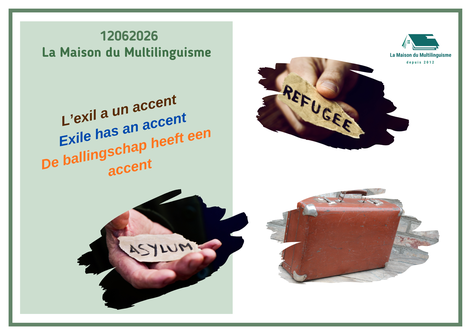
Quand j'ai lu cette phrase pour la première fois, cela m'a surpris. L'exil a un accent. Plus j'y réfléchis, plus c'est exact, plus on se rend compte que l'intégration est rendue difficile par
l'accent que l'on peut avoir.
Je suis donc partie à la recherche d'informations pour mieux comprendre, pour mieux réagir à cette phrase. On pourrait même dire, la migration a un accent, ou encore l'expatriation a un accent.
Mais, pourquoi ?
Dans son livre, "L'accent, traces de l'exil", Céline Masson écrit que la langue parlée par chacun porte les traces de ses origines. Cette langue a une saveur, un accent. Elle explique que
cet accent évolue dans une nouvelle langue, conservant des souvenirs de la langue première. L'accent témoigne d'une culture, qui a un rythme qui fait partie de cette langue première.
Même Madame Germaine de Staël (1766-1817) - condamnée à l'exile par Napoléon raconte dans son roman "Corinne ou l'Italie" que l'accent la trahit. Que c'est un test à son droit d'asile. Il est une frontière invisible mais bien existante. L'accent peut devenir le poids constant de l'exil au milieu de personnes qui parlent leur langue maternelle. Car il est toujours entendu. On ne peut pas l'enlever, il est là. Il peut avoir ses beautés, mais également peut empêcher d'avancer.
Même aujourd'hui, l'accent peut vous rendre étranger. L'auteur bosniaque, V´lobor Colic, installé en France le dit lui même en 2011 : "Quand je suis retourné en Bosnie, on m'a dit que j'avais un
accent français. Être étranger, c'est ça : avoir un accent partout" (voir article dans bibliographie)
Dans un podcast de France Culture - publié en 22, Andrea Cohen dit " Je trimballe mon accent comme la preuve de mon origine. [...] Quand je parle ça sonne différent, je sonne différent."
Elle a décidé de collecter des phrases parfois assez violentes que l'on entend souvent comme "Elle a un accent à couper au couteau", mais parfois c'est plus gentil : "votre accent, c'est du
soleil" (voir bibliographie).
Alain Fleischer en 2005 parle de l'accent comme d'une langue fantôme (voir bibliographie). Dès que quelqu'un parle, dès que l'on entend ne serait-ce qu'un seul mot, il y a l'écho d'une autre
langue, cette langue qu'il appelle langue fantôme, qui s'invite dans la conversation. Elle a ses sonorités, ses contours phonétiques, même si l'on essaye de l'oublier, elle est toujours
là.
L'accent est un signe d'appartenance. Il ne faut pas en avoir honte, mais il ne faut pas non plus faire remarquer à l'autre qu'il parle "différemment". C'est un écart par rapport à une norme
locale, mais est-ce mauvais ? Une langue est faite pour vivre et évoluer. Cet accent montre une dissemblance par rapport à une majorité locale, mais il est aussi une ressemblance à une
communauté.
Deux syllabes suffisent écrit-il : "i j’ai commencé ce livre en écrivant que deux syllabes suffisent, c’est en pensant à la façon dont mon père, répondant au téléphone en français, prononçait le
simple mot « Allô », deux syllabes qui suffisaient à tout familier du hongrois pour déceler instantanément l’accent indélébile de cette langue. Et il me suffit encore aujourd’hui d’entendre une
certaine façon de dire « Allô » au téléphone pour identifier l’origine hongroise d’un interlocuteur" (page 13)
L'accent fait partie de l'identité, de l'auto-biographie de la personne. Il est son empreinte.
Je travaille activement pour aider les familles à transmettre leur langue, je devais dire leur langue et leurs accents - ce qui marquent qui ils sont dans un endroit autre.
J'aurais plaisir à lire vos réactions sur cette question de l'accent - car au-delà d'être marqueur d'identité - tout comme cette question de devoir être locuteur natif, il peut être
injustement handicapant. Et quand on parle d'intégration et d'inclusion, pourquoi l'accent reste-t'il un facteur d'exclusion ? Je vous pose la question.
N'hésitez pas à réagir et à participer aux formations que je propose sur les langues et la mise en place du multilinguisme dans toutes les strates de la société.
[EN]
When I first read this sentence, it surprised me. Exile has an accent. The more I think about it, the more accurate it becomes, the more you realize that integration is made difficult by the
accent you might have.
So I went in search of information to better understand, to better respond to this. You could even say that migration has an accent, or expatriation has an accent. But why?
In her book, "L'accent, traces de l'exil" (Accent, Traces of Exile), Céline Masson writes that the language spoken by each person carries traces of their origins. This language has a flavor, an
accent. She explains that this accent evolves in a new language, retaining memories of the first language. The accent testifies to a culture, which has a rhythm that is part of that first
language.
Even Madame Germaine de Staël (1766-1817) —condemned to exile by Napoleon— recounts in her novel "Corinne, or Italy" that her accent betrayed her. That it was a test for her right to
asylum. It is an invisible but it has very real borders. An accent can become the constant burden of exile among people who speak their mother language. Because it is always heard. You cannot
take it away; it's there. It can have its charms, but it can also prevent you from moving forward.
Even today, an accent can make you feel like a stranger. The Bosnian author, V'lobor Colic, who lives in France, said in 2011: "When I went back to Bosnia, people told me I had a French accent.
That's what being a foreigner is all about: having an accent everywhere" (see article in bibliography).
In a France Culture podcast—published in 2022—Andrea Cohen says, "I carry my accent around like proof of my origins. [...] When I speak, it sounds different, I sound different." She decided to
collect phrases, sometimes quite harsh, that one often hears, such as "She has a very thick accent," but sometimes it's kinder: "Your accent is like sunshine" (see bibliography).
Alain Fleischer, in 2005, spoke of accent as a phantom language (see bibliography). As soon as someone speaks, as soon as you hear even a single word, there's an echo of another language, this
language he calls a phantom language, which intrudes on the conversation. It has its own sounds, its own phonetic contours, and even if you try to forget it, it's always there.
An accent is a sign of belonging. You shouldn't be ashamed of it, but you also shouldn't point out to others that they speak "differently." It's a deviation from a local norm, but is that a bad
thing? A language is meant to live and evolve. The accent shows a difference from the local majority, but it's also a resemblance to a community.
Two syllables are enough, he writes: "If I began this book by writing that two syllables are enough, it was thinking of how my father, answering the phone in French, pronounced the simple word
'Allô,' two syllables that were enough for anyone familiar with Hungarian to instantly detect the indelible accent of that language. And even today, I only need to hear a certain way of saying
'Allô' on the phone to identify the Hungarian origin of the person I'm speaking to" (my translation - page 13).
Accent is part of identity, of a person's autobiography. It is their imprint.
I work actively to help families pass on their language; I should now say their language and their accents — those things that mark who they are in another place.
I would be interested in reading your reactions to the question of accents — because beyond being a marker of identity, just like the requirement to be a native speaker, it can be an
unfair handicap.
And when we talk about integration and inclusion, why does accent remain a factor of exclusion? I am asking you.
Please feel free to share your thoughts and participate in the training sessions I offer on language and the implementation of multilingualism at all levels of society.
[NL]
Toen ik deze zin voor het eerst las, was ik verrast. Ballingschap heeft een accent. Hoe meer ik erover nadenk, hoe meer ik besef dat integratie bemoeilijkt wordt door het accent dat iemand
heeft.
Daarom ben ik op zoek gegaan naar informatie om deze zin beter te begrijpen en er beter op te kunnen reageren. Je zou zelfs kunnen zeggen dat migratie een accent heeft, of dat expatriatie een
accent heeft. Maar waarom?
In haar boek "L'accent, traces de l'exil" (Accent, sporen van ballingschap) schrijft Céline Masson dat de taal die ieder mens spreekt sporen van zijn of haar afkomst draagt. Deze taal heeft een
eigen karakter, een accent. Ze legt uit dat dit accent zich ontwikkelt in een nieuwe taal, terwijl het de herinneringen aan de moedertaal behoudt. Het accent getuigt van een cultuur, met een
ritme dat deel uitmaakt van die moedertaal.
Zelfs Madame Germaine de Staël (1766-1817) – die door Napoleon tot ballingschap werd veroordeeld – vertelt in haar roman "Corinne, of Italië" dat haar accent haar in de steek liet. Dat het een
test was van haar recht op asiel te hebben. Het is een onzichtbare, maar zeer reële grens. Een accent kan een constante last worden voor mensen die hun moedertaal spreken en daardoor in
ballingschap leven. Omdat het altijd hoorbaar is. Je kunt het niet wegnemen; het is er. Het kan zijn charmes hebben, maar het kan je ook belemmeren om vooruit te komen.
Zelfs vandaag de dag kan een accent je het gevoel geven een vreemdeling te zijn. De Bosnische auteur V'lobor Colic, die in Frankrijk woont, zei het zelf in 2011: "Toen ik terugging naar Bosnië,
zeiden mensen dat ik een Frans accent had. Dat is waar het bij een buitenlander om draait: overal een accent hebben" (zie artikel in de bibliografie).
In een podcast van France Culture – gepubliceerd in 2022 – zegt Andrea Cohen: "Ik draag mijn accent met me mee als bewijs van mijn afkomst. [...] Als ik spreek, klinkt het anders, ik klink
anders."
Ze besloot zinnen te verzamelen, soms nogal hard, die je vaak hoort, zoals "Ze heeft een heel zwaar accent", maar soms ook vriendelijker: "Je accent is als zonneschijn" (zie bibliografie).
Alain Fleischer sprak in 2005 over een accent als een spooktaal (zie bibliografie). Zodra iemand spreekt, zodra je zelfs maar één woord hoort, is er een echo van een andere taal, deze taal noemt
hij een spooktaal, die zich in het gesprek mengt. Die taal heeft zijn eigen klanken, zijn eigen fonetische contouren, en zelfs als je probeert hem te vergeten, is hij er altijd.
Een accent is een teken van verbondenheid. Je hoeft je er niet voor te schamen, maar je moet anderen er ook niet op wijzen dat ze "anders" spreken. Het is een afwijking van de lokale norm, maar
is dat per se iets slechts? Een taal is bedoeld om te leven en te evolueren. Dit accent laat een verschil zien met de lokale meerderheid, maar het is ook een overeenkomst met een
gemeenschap.
Twee lettergrepen zijn genoeg, schrijft hij: "Als ik dit boek begon met de opmerking dat twee lettergrepen genoeg zijn, dacht ik aan hoe mijn vader, die de telefoon in het Frans opnam, het
simpele woord 'Allô' uitsprak. Twee lettergrepen die genoeg waren voor iedereen die Hongaars sprak om direct het onuitwisbare accent van die taal te herkennen. En zelfs nu hoef ik alleen maar een
bepaalde manier van 'Allô' horen om aan de telefoon te weten of de persoon met wie ik spreek van Hongaarse afkomst is" (min vertaling - pagina 13).
Een accent is onderdeel van iemands identiteit, van iemands autobiografie. Het is hun stempel.
Ik zet me actief in om families te helpen hun taal door te geven; ik moest hun taal en hun accenten – die dingen die bepalen wie ze zijn – in een andere wereld tot uitdrukking brengen.
Ik zou graag uw reacties op het onderwerp accenten lezen – want behalve dat het een identiteitskenmerk is, net als de eis om een moedertaalspreker te zijn, kan het
ook een oneerlijke handicap zijn. En als we het hebben over integratie en inclusie, waarom blijft een accent dan toch een factor van uitsluiting? Dat vraag ik u.
Deel gerust uw gedachten en neem deel aan de trainingen die ik aanbied over talen en de implementatie van meertaligheid op alle niveaus van de samenleving.
Bibliographie :
Colic, Velibor - "Être étranger, c'est avoir un accent partout" - 2011
Fleischer, Alain, L'accent, une langue fantôme - 2005 - La Libraire du XXIe siècle - Seuil
Masson, Céline - L'accent, traces de l'exil - 2016 - Éditions Hermann
Staël, Germaine de. Corinne, ou l'Italie - 1807, Folio Classique
Mon accent étranger - dimanche 11 décembre 2022



Écrire commentaire